Choosing the right Power Frequency Converter really matters when it comes to efficiency—it's not just about plugging something in. According to some industry stats from the International Electrotechnical Commission, if you pick the wrong one, you could lose over 15% of energy. And honestly, that kind of loss isn’t just a number; it adds up to serious costs over time. It’s pretty eye-opening how much small choices can impact your budget.
John Smith from PowerTech Solutions again hits the nail on the head—he stresses that you’ve gotta match the converter to what you really need now, and also think ahead. I mean, it’s easy to forget that your needs might change down the line, and then you end up with something that just doesn’t cut it.
When you're trying to figure out which converter to go for, keep an eye on the key stuff like input voltage and how much power it can handle. Honestly, don’t rush this decision. It’s worth chatting with professionals and digging into some technical resources. Spending a little extra time researching now can seriously pay off later in smoother operation and fewer headaches. So, take your time, weigh your options, and trust me—finding the right fit means fewer problems down the road and a more reliable setup.”
Understanding Power Frequency Converters: An Overview
Understanding the basics of power frequency converters is essential for making informed decisions. These devices convert electrical power from one frequency to another. They play a crucial role in various applications, from industrial machinery to renewable energy systems. According to a recent industry report, the global power frequency converter market is expected to grow by 6.7% annually through 2025.
When selecting a power frequency converter, consider your specific needs. Factors include load requirements, efficiency ratings, and compatibility with existing systems. Ensuring that the converter provides the correct frequency output for your application is critical. An ill-suited converter may lead to equipment malfunction or energy waste.
Tips: Always check the manufacturer’s specifications. Look for converters that offer adjustable frequency settings. This feature provides flexibility for future upgrades or different applications. Make sure to evaluate the total cost of ownership, not just the initial price.
Power frequency converters can be complex, and misjudgments can happen. For instance, some users oversize their converters, resulting in higher operational costs. Others may overlook the importance of thermal management. Ignoring these details could lead to inefficiency.
Identifying Your Power Requirements and Specifications
When selecting a power frequency converter, understanding your power requirements is crucial. Consider the type of equipment you operate. Different machines need various power inputs. For example, industrial motors typically require more substantial power than small electronic devices. According to a recent report by the International Electrotechnical Commission, about 30% of machinery failures are linked to improper power supply.
Identify your voltage and frequency needs accurately. Some regions use 50 Hz, while others operate at 60 Hz. Mismatched frequencies can harm equipment. You must also factor in the total load your converter will handle. This includes not only the peak power consumption but also any potential surges during operation.
Tip: Always choose a converter rated 20% higher than your maximum load. This ensures reliability and longevity. Regular assessments of your equipment’s power needs are also essential. Equipment upgrades may change your requirements, making it necessary to reassess your converter’s specifications.
Be wary of oversizing your converter. While it may seem safe, it can reduce efficiency. A report by the Department of Energy suggests that using an oversized converter can waste up to 15% of energy. Adjusting your choice based on precise requirements will enhance efficiency and performance.
Comparing Different Types of Power Frequency Converters
When choosing a power frequency converter, understanding the different types available is crucial. These converters can be broadly categorized into static and rotary types. Static converters are generally more efficient, offering over 90% efficiency rates. They are compact and ideal for smaller applications. However, they may not handle large power demands as well as rotary converters can.
Rotary converters are larger and can manage higher power loads, often exceeding
1,000 kVA. They operate based on rotating machinery that converts power frequency efficiently. Reports indicate that rotary types might be less efficient, often ranging between
85-90%. Nonetheless, they excel in providing stable output across varying loads, which is critical in
industrial settings.
Choosing the right type depends heavily on your specific needs and application requirements. Static converters can be limited in high-demand environments. In contrast, rotary converters may take up more space and require more maintenance. It's essential to analyze the characteristics and limitations of each type to make an informed decision. This evaluation can prevent costly mistakes or inefficiencies in your setup.
Evaluating Output Frequency and Voltage Types
Choosing the right power frequency converter can be complex. One key aspect is output frequency. Different devices require different frequencies to operate efficiently. For instance, some machinery runs best at 50 Hz, while others adapt to 60 Hz. It’s crucial to match the converter’s output to the equipment’s specifications. Failing to do so can result in poor performance or damage.
Voltage types are another critical consideration. You need to know whether your equipment requires single-phase or three-phase voltage. Incorrect voltage levels can lead to overheating, short circuits, or reduced lifespan of the equipment. Additionally, voltage fluctuations can affect stability. An over- or under-voltage situation might not immediately arise, making it easy to overlook.
It's also important to evaluate the load characteristics. Some applications demand a surge current at startup, while others may run continuously. Understanding these details can guide you in selecting the right converter. The selection process is not always clear-cut. Often, the nuances in power ratings and compatibility may cause confusion. It's worth spending time to reflect on these factors before making a decision.
How to Choose the Right Power Frequency Converter for Your Needs?
| Parameter | Description | Recommended Value |
| Output Frequency | The frequency output required for your application. | 50 Hz / 60 Hz |
| Output Voltage | The voltage required to match your equipment requirements. | 230V / 400V |
| Power Rating | The maximum power the converter can handle. | 1kW - 100kW |
| Phase Type | Single-phase or three-phase output. | Single-phase / Three-phase |
| Input Voltage Range | The range of input voltage that the converter can accept. | 100V - 480V |
| Cooling Method | How the converter dissipates heat. | Air-cooled / Liquid-cooled |
Assessing Efficiency and Performance Ratings
When choosing a power frequency converter, efficiency is key. Look for models that have high performance ratings. These ratings often reflect how well the converter handles load variations. An efficient converter uses less energy, which is essential for both cost savings and sustainability.
Consider the application you need the converter for. Certain industries may have specific efficiency requirements. A converter with a slightly lower rating may suffice in less demanding environments. However, in critical applications, even small differences matter. Remember, a high rating does not guarantee complete satisfaction. Evaluate your needs carefully.
Performance ratings also reveal how a converter operates under stress. Some units may falter when pushed to their limits. Think about future expansions in capacity. Will your chosen model adapt? A well-rated converter can handle unexpected demands. Yet, it’s vital to connect its practical capabilities with real-world conditions. Choices made today should consider tomorrow’s challenges.
Considering Installation and Maintenance Needs
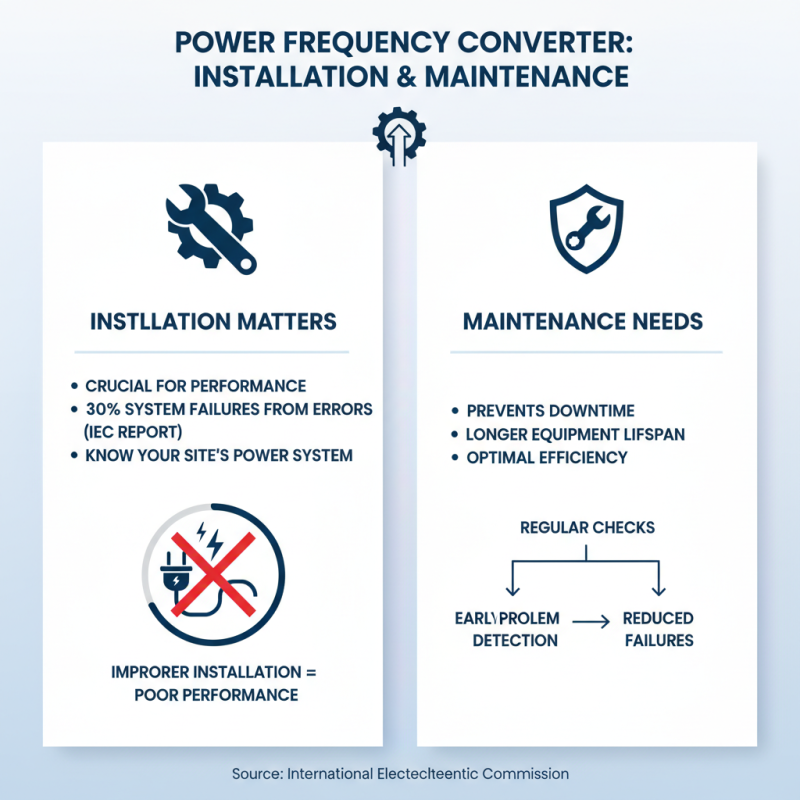
When choosing a power frequency converter, considering installation and maintenance needs is crucial. A report from the International Electrotechnical Commission states that improper installation can lead to significant performance issues. It highlights that 30% of system failures stem from installation errors. Understanding your site's power system can prevent common pitfalls.
Installation requires thorough planning. Assess space, cooling requirements, and accessibility for maintenance. However, many overlook the importance of these factors. A report by IEEE reveals that 20% of maintenance costs arise from poorly planned setups. You may end up spending more on repairs than needed.
**Tips:** Opt for converters with modular designs. They simplify upgrades and maintenance. Regularly check connections and components to spot potential issues early. Training your staff on basic troubleshooting can also mitigate downtime. Remember, a little attention can lead to substantial savings in the long run.
Budgeting and Choosing Between Brands and Models
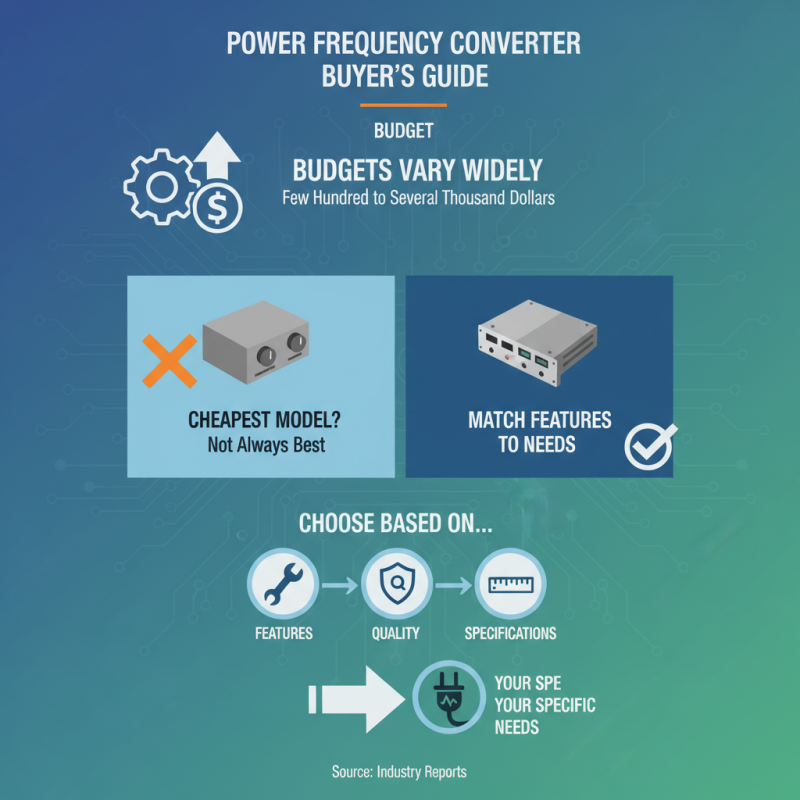
Choosing the right power frequency converter can be overwhelming. Budgets vary widely based on features, quality, and specifications. Reports indicate that prices can range from a few hundred to several thousand dollars. Look for features that match your specific needs, rather than simply opting for the cheapest model.
When it comes to brands, reputation matters. However, it's essential to research beyond brand names. User reviews can provide invaluable insights. Look for converters with at least 4-star ratings. Professional reports suggest that user experiences can reveal issues that sales materials do not. Sometimes, an unknown brand could outperform a more well-known counterpart.
Tips: Always consider the specific voltage and frequency requirements for your equipment. A mismatch can lead to inefficiencies or damage. Don't rush your decision; taking the time to weigh your options can save money in the long run. Reflect on the power efficiency and durability over cost alone. A high initial investment might yield better long-term results.
Conclusion
In the selection process of a Power Frequency Converter, understanding the fundamental characteristics of these devices is crucial. Begin by identifying your specific power requirements and specifications, as this will guide your decision-making. It is essential to compare the various types of power frequency converters available, taking into account factors such as output frequency and voltage types, which affect compatibility with your electrical systems.
Additionally, assessing the efficiency and performance ratings of different models can help determine their reliability and suitability for your needs. Consideration of installation and maintenance requirements is also necessary to ensure long-term functionality. Lastly, budgeting effectively while comparing brands and models will allow you to find the right Power Frequency Converter that meets both your operational needs and financial constraints.